
 Italiano
Uncategorized, Padel
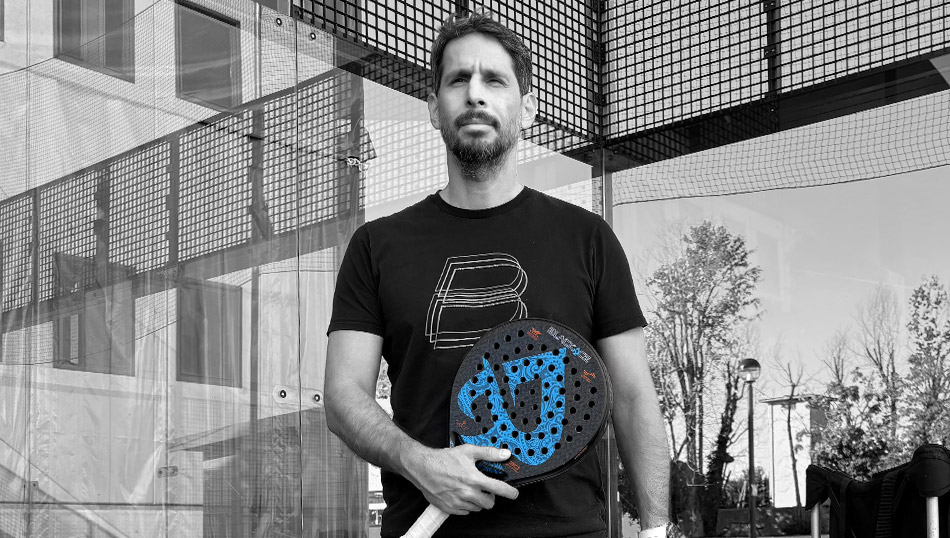
Fernando Barrios: “Every player has potential to fulfil. My job is to find the right way to help them grow.”
Oct
From a background in sports law to coaching young competitive players, through biomechanics, neuroscience and technology. We met Fernando Barrios, coach and Sports Director at Sport Lab, to talk about his method, his work with young players and his collaboration with Prokennex.
Fernando, let’s start from the beginning. Your journey into padel is quite unusual. How did it begin?
“I’ve always been an amateur sportsman and, over the years, I’ve practised many different sports: judo, basketball, football, squash, cycling, running and mountain running. Beyond sport, however, I think the characteristic that best defines me has always been curiosity — that constant desire to explore and understand how things work.
My academic background reflects this attitude as well. Over the years, I attended different universities and completed master’s programmes, while continuing my education in a wide range of fields: from law and sports management to padel coaching and neuroscience applied to sport. I was working as a lawyer, and sports law, together with my education in sports management, gradually brought me closer to this world from a professional perspective as well. I started in padel as an instructor before moving into the management and development of several academies. Today, I mainly work in technical direction and coaching, with a particular focus on competitive junior players.”
When did you realise that coaching was going to become more than just an activity for you?
“I started by attending several training courses, but the real turning point came when I met a world-class professional coach who really made me passionate about coaching and gave me the opportunity to explore padel from a completely different perspective. From there, I had the opportunity to open and manage several academies and to provide training in different parts of Italy. It was a very important experience, although at a certain point the project came to an end because of different views about how it should develop.
What stayed with me most from that experience, however, was what I had learned. I tried to make that knowledge my own, continuing to study and gradually developing a deeper understanding and vision of padel.
When I started coaching directly again, I realised that everything had become much easier: I had a different understanding of the game, and what I was proposing to the players was working very well.”
What is your role at Sport Lab today, and what exactly do you do?
“I’ve been at Sport Lab, in Castel Goffredo, for about two years. My main role is coordinating the competitive junior programme for the Under 12, Under 14, Under 16 and Under 18 age groups.
To be honest, when I started, I didn’t have a great deal of specific experience in junior competitive padel. When I was offered the opportunity to develop an academy dedicated to young players, I became extremely interested in the idea. I started with two players, and for the first six months we made a very clear decision: no tournaments and no matches. Just training. I wanted them first to understand my idea of padel. After six months, we started competing and the results began to come as well.
From there, the project grew and several of our players went on to be selected for regional squads.”
What is the key element that distinguishes your coaching method?
“I think it’s the ability to adapt my teaching to the person in front of me. Every young player is different in terms of age, coordination, physical characteristics and learning ability. I can’t use the same system with everyone and expect the same result. When I hear a coach say, ‘this player can’t do it,’ I don’t agree. It isn’t necessarily the player who can’t do it; perhaps you, as the coach, haven’t yet found a way to simplify what you’re explaining enough. Maybe that player needs more time, more repetitions, needs the movement to be broken down into more steps, or needs different tools.
The coach’s job is to find that way.”
So you don’t believe natural talent is the determining factor?
“Of course, every person has different characteristics and not everyone will reach the same level. But I can help every young player reach the maximum of what that individual is capable of achieving. I can teach coordination, technique and movement. What I can’t completely control is what is going on inside the player’s head: determination, willingness to train, the ability to deal with defeat and the desire to keep going. Some of my biggest surprises have come from players who initially seemed to struggle more than others, but who never gave up.
That’s why I don’t rule anyone out”.
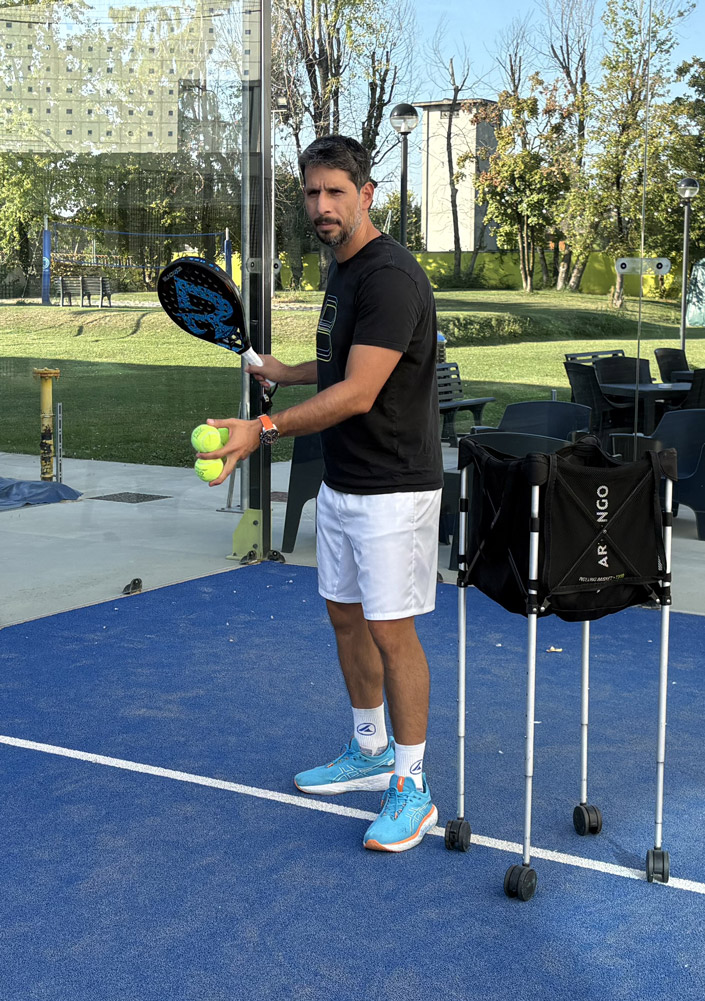
Your method incorporates biomechanics, neuroscience and even physics. Why?
“Because I want to understand what is really happening. If I understand why a racket accelerates, why a ball spins, how the body moves or what forces are involved during a shot, I can then find a way to simplify all of that for a ten- or eleven-year-old player. Obviously, I don’t go to a young player and start explaining biomechanics. I study it myself so that I can find a simple explanation that works for them.
My approach is theoretical and analytical, but it always has to translate into practice. Ultimately, I need to achieve a result.”
Is this research-driven approach what brought you closer to Prokennex?
“Yes, when I met Prokennex, what initially appealed to me most was the opportunity to have a more direct relationship. I wanted to be able to talk not only about commercial aspects, but also about what I was feeling and what my players were experiencing when using the rackets. Then I started looking more deeply into what was behind the product and realised that we had something in common: studying in order to achieve a result.
When I explored the technologies, materials and construction of the rackets in greater depth, I found a level of quality and attention to detail that I consider above average. And that is something I strongly identify with.”
What impressed you most about the Kinetic System?
 “Before I really got to know it, I had a very different perception. Prokennex is often associated primarily with arm protection and the prevention of elbow problems. But when I discovered what actually happens inside the racket and how the Kinetic Mass works, my perspective changed.
I began looking at the technology not only from the point of view of comfort, but also in terms of performance. I think this is particularly important when talking to young players. A young player wants to know what they can gain on court: greater stability, response on impact, control and performance. Then, of course, there is also the benefit of reduced vibrations.”
How important is the quality of the equipment in your daily work with your players?
“Very important. Our training method involves many hours of live-ball rallies, so the players use their rackets constantly. I’ve had them try different Prokennex models precisely because I believe in the quality of the materials and of each racket. Then, of course, everyone has to find the one that best suits their individual characteristics and style of play.
Another reason I introduced Prokennex to the players is the opportunity to have a brand that is genuinely close to them. For a young athlete, I think it’s a great opportunity to be able to grow alongside a brand that can support them directly throughout their journey.”
How many young competitive players are you currently coaching?
“About fourteen. Five or six are already competing in national and international competitions, while the others are beginning their competitive journey. Together with Prokennex, we have already established direct partnerships with some of the players, who have individually signed their own agreements with the brand.”
Looking ahead, what goal would you like to achieve with your players?
“I would like to take one of my players to the top level in Italy and among the leading players internationally. I don’t consider it an unrealistic dream. I believe it’s possible, but it takes time. Reaching the professional level, however, doesn’t depend solely on technical ability. You need the resources to travel, compete internationally and test yourself against the best. In padel, you also need to find a partner who has both the quality and the opportunity to follow the same path.
My goal is to guide these players all the way to professional competition.”
Is there something you want your players to take away from this experience beyond sporting results?
“Absolutely, and it’s probably one of the things I care about most. How many of the players I coach will become professionals? Maybe one in fifty. The others will pursue different careers and take different paths. But through sport they can learn much more than how to hit a ball: having a method, respecting the rules, maintaining control, being competitive but fair, dealing with defeat and, above all, looking for a solution when something isn’t working.
When I’m on the bench, I have only a few seconds to understand what is happening, give a player some guidance and send them back onto the court. When that solution works, the satisfaction is priceless.
At the end of the day, you always have young people in front of you. You’re not just teaching them how to play padel.”.